
News
India and the Nordics Deepen Strategic Partnership Ahead of 2026 Summit
As Prime Minister Narendra Modi prepares to attend the 3rd India–Nordic Summit in Oslo on May 19, 2026, India’s engagement with Denmark, Finland, Iceland, Norway, and Sweden is entering a new strategic phase centered on sustainability, defence cooperation, maritime infrastructure, clean energy, and Arctic governance.
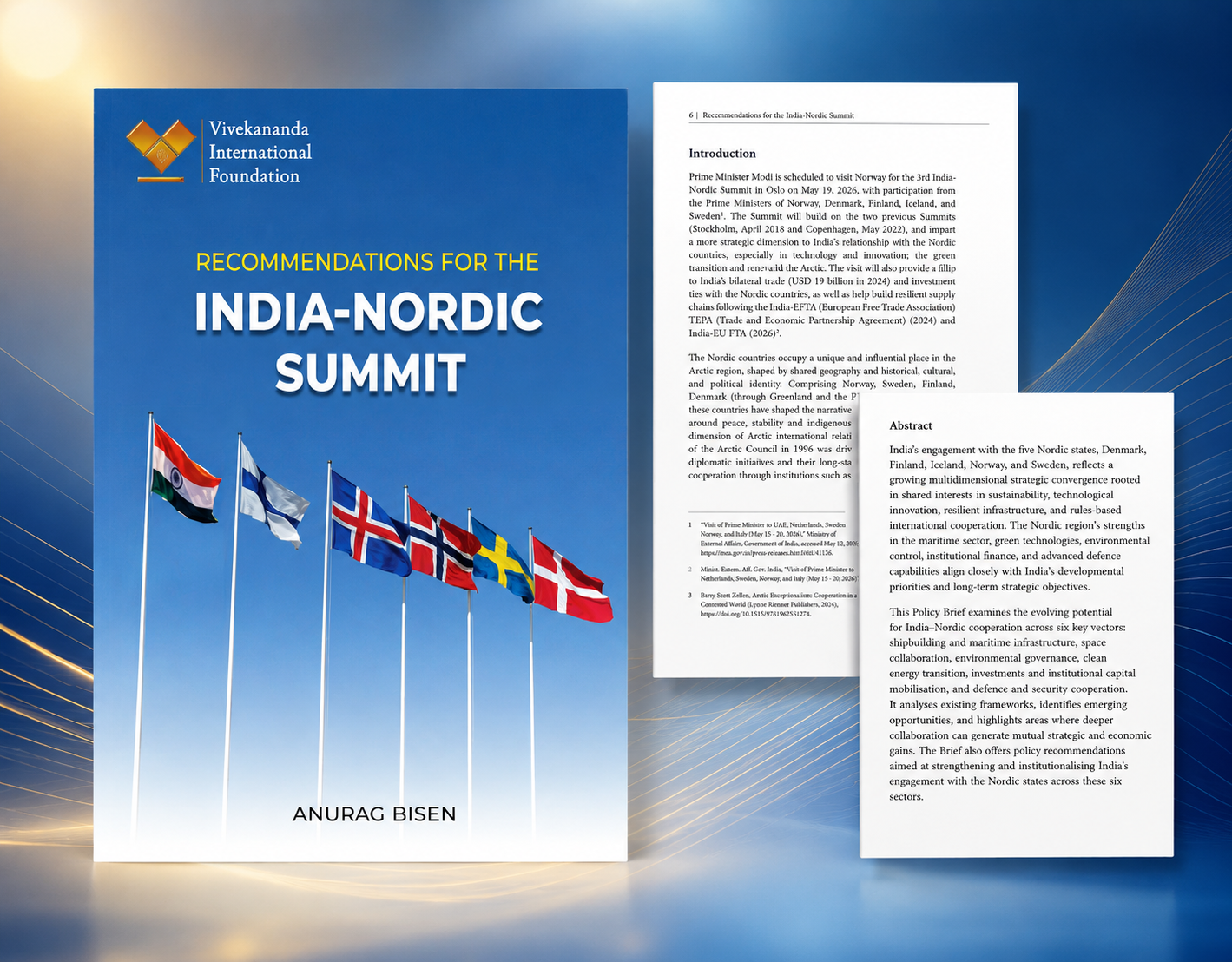 A new policy brief by strategic affairs expert Anurag Bisen argues that the partnership between India and the Nordic region is evolving into a “multidimensional strategic convergence” driven by shared interests in resilient infrastructure, technological innovation, and rules-based international cooperation.
The report, Recommendations for the India-Nordic Summit, published by the Vivekananda International Foundation, highlights how Nordic expertise in shipbuilding, renewable energy, Arctic research, institutional finance, and advanced defence systems aligns closely with India’s long-term developmental and geopolitical priorities.
Arctic Cooperation Moves to the Forefront
One of the key themes of the policy brief is the growing importance of Arctic cooperation. The Nordic countries occupy a central role in Arctic governance and sustainable development, while India has steadily expanded its Arctic presence over the last decade through scientific expeditions, climate research, and policy initiatives.
India has maintained its Himadri research station in Svalbard since 2008 and released its Arctic Policy in 2022 under the theme “Building a Partnership for Sustainable Development.” The policy emphasizes scientific research, climate change mitigation, and economic cooperation in the Arctic region.
The report notes that Nordic nations possess disproportionate influence in Arctic affairs due to their leadership in ice-class shipbuilding, renewable energy, polar research, and critical mineral extraction. Greenland’s rare earth and uranium reserves, Finland’s icebreaker technology, Iceland’s Arctic science initiatives, Norway’s marine governance expertise, and Sweden’s space infrastructure are all identified as areas of strategic relevance for India.
Maritime and Shipbuilding Cooperation Gains Momentum
The policy brief places significant emphasis on maritime collaboration, particularly in shipbuilding and green shipping technologies. Denmark’s Odense Maritime Technology ecosystem and Finland’s Aker Arctic are highlighted as potential partners for Indian shipyards such as Cochin Shipyard Limited, Mazagaon Dock Shipbuilders, and Garden Reach Shipbuilders & Engineers.
India aims to become one of the world’s top ten shipbuilding nations by 2030 and capture five percent of the global shipbuilding market. To achieve this, the report recommends deeper Nordic partnerships focused on design expertise, green shipping technologies, and ice-class vessel construction.
The document also warns of India’s vulnerability in energy transportation. During the March 2026 Strait of Hormuz disruption, India faced severe supply risks because almost all LNG and LPG imports are carried on foreign-flagged vessels. The brief argues that collaboration with Nordic maritime firms is critical for developing indigenous LNG and LPG carriers and strengthening India’s energy security.
Polar Research Vessel Project Revived
A major development highlighted in the report is India’s renewed effort to build its first indigenous Polar Research Vessel (PRV). In 2025, Garden Reach Shipbuilders signed a memorandum of understanding with Norway’s Kongsberg for design cooperation on the vessel. The revised project cost stands at ₹2,329 crore, with delivery expected by 2029–30.
The vessel is expected to strengthen India’s scientific research capabilities in both the Arctic and Antarctic while reducing reliance on expensive foreign-chartered ice-class ships.
Space Collaboration Expands Through Sweden
Space cooperation is another emerging pillar of India–Nordic relations. Sweden’s Esrange Space Centre in Kiruna has become increasingly important for India’s satellite tracking and Earth observation ambitions. The Swedish Space Corporation has already supported telemetry for India’s Chandrayaan-3 mission and private Indian space company Dhruva Space’s LEAP-1 mission.
The report recommends that India establish Arctic ground station capabilities in Sweden to improve satellite data frequency for agriculture, weather forecasting, and disaster management. Enhanced Earth observation could significantly improve monsoon prediction and precision agriculture across India.
Clean Energy and Climate Technologies
The Nordic countries’ expertise in renewable energy and environmental management is another major focus area. Iceland’s geothermal energy leadership and carbon capture technologies are highlighted as promising opportunities for collaboration.
The report notes that India possesses an estimated 10.6 GW geothermal potential and could benefit from Icelandic technical support in regions such as Ladakh, Himachal Pradesh, and the Andaman & Nicobar Islands. Iceland’s CarbFix carbon mineralization project is also cited as a potential model for carbon sequestration in India’s Deccan Traps basalt formations.
Norway’s expertise in marine spatial planning and pollution control is similarly identified as valuable for India’s coastal and riverine management systems, especially in ecologically sensitive regions like the Sundarbans and the Gulf of Mannar.
Nordic Investment Seen as Strategic Opportunity
The report argues that India is well-positioned to attract large-scale Nordic institutional capital into green infrastructure, offshore wind, shipbuilding, hydrogen, and maritime logistics. Nordic sovereign wealth and pension funds collectively manage more than $2 trillion in assets, including Norway’s Government Pension Fund Global, one of the world’s largest sovereign wealth funds.
Because Nordic investment frameworks strongly prioritize Environmental, Social, and Governance (ESG) standards, India’s clean energy transition and sustainable infrastructure initiatives present an attractive long-term opportunity for Nordic investors.
Defence Cooperation and Arctic Security
The brief also recommends expanding defence cooperation with the Nordic states through structured military engagement under frameworks such as NORDEFCO, the Nordic Defence Cooperation platform.
Potential cooperation areas include anti-submarine warfare, cold-weather logistics, maritime domain awareness, and Arctic operational training. The report notes that Nordic naval expertise in shallow-water anti-submarine operations and Arctic warfare could complement India’s own experience in high-altitude and maritime operations.
It additionally recommends establishing expanded Indian defence representation across the Nordic region, including a naval defence attaché in Oslo.
A Strategic Partnership with Global Implications
The policy brief concludes that India and the Nordic countries possess highly complementary strengths. Nordic states contribute advanced technology, Arctic governance influence, and institutional capital, while India offers manufacturing scale, infrastructure demand, and long-term growth potential.
According to the report, deeper India–Nordic cooperation could lead to indigenous ice-capable shipbuilding, improved climate and agricultural forecasting, enhanced renewable energy capabilities, stronger maritime security, and more resilient global supply chains.
The upcoming India–Nordic Summit in Oslo is therefore expected to mark not only a diplomatic engagement, but also a strategic recalibration of India’s role in Arctic governance, green technology partnerships, and global maritime security.
Source: Anureg Bisen
The tags below provide an opportunity to view previously posted related news within the selected category