
News
A new launch Announcement, the Polar Observing Site Hub (POSH), is now available.
POSH: a new discovery portal for research and monitoring sites at high latitudes.
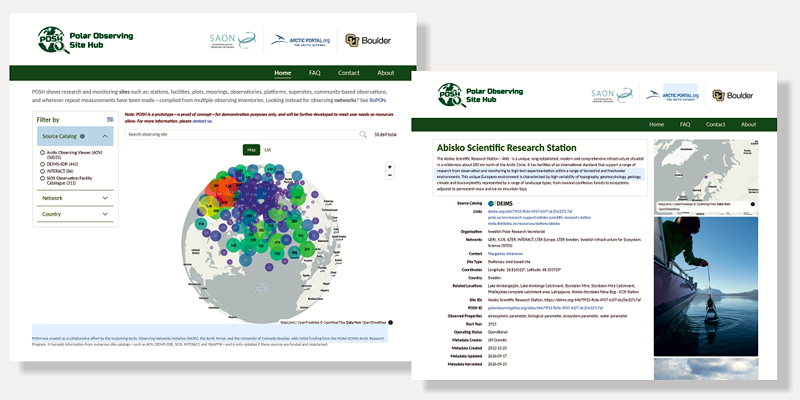
A new resource,the Polar Observing Site Hub (POSH), is now available. It compiles details from multiple observing inventories for over 50,000 research and monitoring sites, such as: stations, observatories, facilities, plots, moorings, platforms, community-based observations, and wherever repeat measurements have been made.
For each site, POSH displays location, site name, description, organization, contact information, associated networks, observed properties, links to data, and more. Overall, it is designed to provide a more comprehensive perspective on where and how observing takes place across the polar regions.
How POSH Works
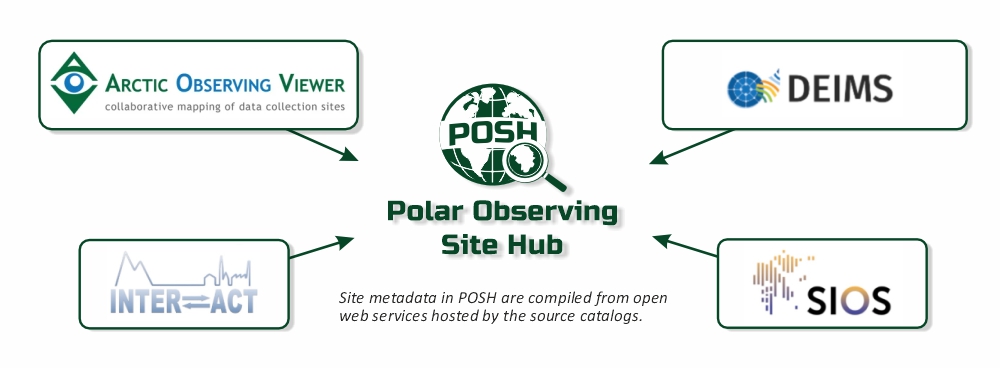
POSH is not the original source for the structured information about observing sites. Instead, it harvests from – and links to – four authoritative source catalogs: the Arctic Observing Viewer (AOV), DEIMS, INTERACT, and SIOS. Because POSH is an aggregator, it does not replace these catalogs. Instead, it relies on them and highlights the need for their continued funding and support. This approach is similar to how modern data catalogs combine search results from multiple data repositories, making it easier for end users to find what they need without visiting numerous disconnected resources.
POSH is currently a prototype for demonstration purposes. It is a test case and proof of concept for aggregating site metadata from an ecosystem of distributed site inventories. As resources allow, POSH will add tens of thousands of sites from other inventories. The end goal is to have a sustainable discovery portal that is distributed, interoperable, extensive, and integrated.POSH focuses on research and monitoring sites, whereas a companion tool – the Registry of Polar Observing Networks (RoPON – is an inventory of the overarching systems or organizations that conduct or coordinate observation and monitoring. They may look similar but serve different purposes. POSH is for individual sites; RoPON is for networks.
Because POSH searches across multiple inventories and dozens of networks simultaneously, it helps to meet the needs of a variety of users:
- science planners to assess status, overlap, and gaps
- network and logistics managers to co-locate or optimize limited resources
- funding officers to avoid duplicated effort
- researchers to collaborate with facilities and projects, to find data, or to calibrate and validate satellite imagery
- and community members to discover, engage with, and leverage observational efforts and data collected nearby.
This tool was created as a collaboration among the Sustaining Arctic Observing Networks initiative (SAON), the Arctic Portal, and the University of Colorado Boulder, with initial funding from the NOAA GOMO Arctic Research Program. It aligns with the vision of the SAON Polar Observing Assets Working Group (POAwg), which has a goal of making observing-related metadata more Findable, Accessible, Interoperable, and Reusable (the FAIR Principles).
Visit POSH at PolarObservingSites.org
Visit ROPON at PolarObservingRegistry.org
The tags below provide an opportunity to view previously posted related news within the selected category