
News
Iceland to Hold Referendum on Resuming EU Membership Talks
The Icelandic government has announced plans to hold a national referendum on 29 August 2026 to decide whether the country should resume negotiations on joining the European Union (EU).
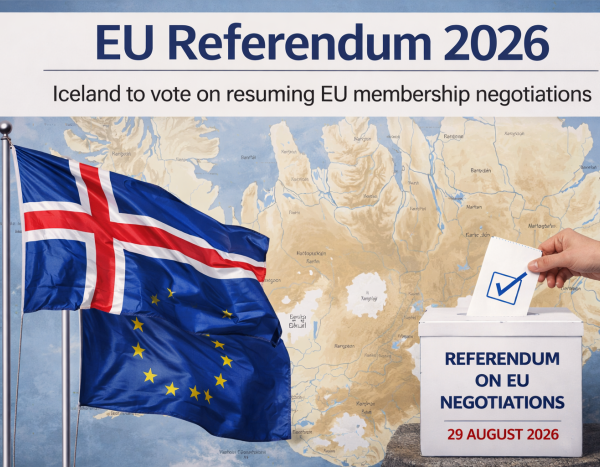 The vote will not determine whether Iceland joins the EU outright, but rather whether accession talks, halted over a decade ago, should be restarted. If voters support reopening negotiations and an agreement is eventually reached, a second referendum would be required to decide on full EU membership.
Background to the Vote
Iceland originally applied for EU membership in 2009 following a severe financial crisis. Formal negotiations began in 2010 and made significant progress, with multiple chapters opened and some provisionally closed. However, talks were suspended in 2013 after a change in government and later set aside politically, though never formally withdrawn.
Despite this pause, Iceland has maintained close ties with the EU. The country participates in the European Economic Area (EEA), which gives it access to the EU’s single market, and is also part of the Schengen Area.
Iceland’s Existing Relationship with the EU
Although not a member state, Iceland is already deeply integrated into European cooperation. Through the EEA Agreement, it takes part in the EU’s internal market based on the “four freedoms”, the free movement of goods, services, capital, and people, and applies a significant portion of EU legislation domestically.
The European Union is also Iceland’s most important trading partner, accounting for the majority of its exports and imports.
Understanding the Debate
The question of EU membership has long been debated in Iceland. The European Union is a supranational organisation in which member states share decision-making power in certain areas, particularly in economic cooperation and the internal market.
Supporters of membership often point to the benefits of closer integration and influence within EU decision-making, while critics emphasize concerns about national sovereignty and control over key sectors such as fisheries. This tension reflects a broader discussion about whether Iceland’s interests are better served through full membership or through existing agreements like the EEA.
Public Opinion Divided
Recent opinion polls suggest that Icelandic public opinion remains divided on EU membership. Surveys conducted in 2025 show that around 44–45% of Icelanders support joining the European Union, while roughly one-third are opposed and a significant share remain undecided. However, there is broader agreement on the need for public consultation, with a clear majority supporting a referendum on whether to resume accession negotiations.
What Happens Next
If the referendum results in a “yes” vote, Iceland would re-enter negotiations with the EU, building on earlier progress. Any final accession agreement would then be subject to a second national referendum.
If voters reject the proposal, the government has indicated that negotiations will not resume.
A Defining Moment
The upcoming vote is expected to be a pivotal moment in Iceland’s modern political history, giving citizens the opportunity to shape the country’s future relationship with Europe.
With public opinion divided and the stakes high, the referendum is likely to spark extensive national debate in the months ahead.
Source: Stjórnarráð Íslands, Vísindavefur, RÚV
The tags below provide an opportunity to view previously posted related news within the selected category