
Icebreakers in the Arctic
The Role of Icebreakers
Icebreakers are specialized vessels designed to navigate through ice-covered waters by breaking sea ice and maintaining safe shipping routes. They play a critical role in Arctic maritime operations, including:
- Commercial shipping
- Resupply of remote communities
- Scientific research
- Search and rescue (SAR)
- Environmental response
- Military and sovereignty patrols
As Arctic sea ice declines due to climate change, seasonal navigation windows have expanded in some regions. However, ice conditions remain highly variable and unpredictable, making icebreaker support essential for safe operations.
A Brief History of Icebreaking
Ice-strengthened ships were used during early polar expeditions. Wooden vessels were reinforced with double planking and iron bands to protect hulls from pressure and ice damage.
The first surface vessel to reach the North Pole was the Soviet nuclear-powered icebreaker Arktika, which did so in August 1977. This marked a milestone in Arctic maritime engineering.
Since then, icebreaker design has advanced significantly. Modern icebreakers feature:
- Reinforced steel hulls
- Sloping bows designed to ride up and crush ice
- Powerful propulsion systems
- Advanced navigation and satellite systems
Types of Icebreakers
Modern Arctic icebreakers are powered by:
- Diesel-electric systems
- Gas turbines
- Nuclear reactors (primarily in Russia)
Nuclear-powered icebreakers can operate for extended periods without refueling and are particularly suited to long Arctic missions.
Heavy-duty icebreakers can typically break:
- Up to 1.5–2 meters (5–7 feet) of continuous ice at slow speeds
- Thicker ridged ice through repeated ramming
Displacement of modern heavy icebreakers often exceeds 15,000–30,000 tons, with Russia’s newest vessels surpassing this.
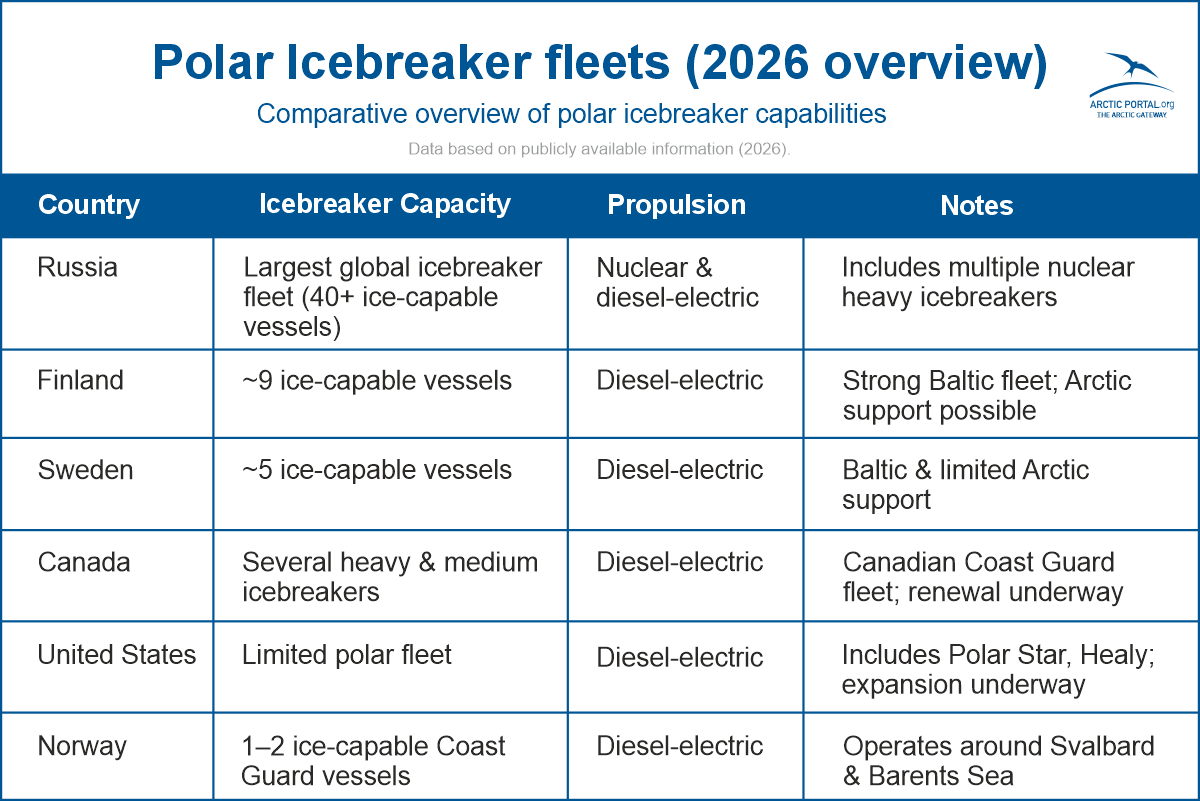
Arctic Icebreaker Fleets (Current Overview)
Russia
Russia operates the world’s largest and most powerful icebreaker fleet, including nuclear-powered vessels. As of the mid-2020s:
- Russia operates over 40 ice-capable vessels, including
- Several nuclear-powered icebreakers
- New Project 22220 vessels (e.g., Arktika, Sibir, Ural)
- Additional vessels are under construction to support the Northern Sea Route
Russia views icebreakers as strategic infrastructure for Arctic development, resource extraction, and year-round navigation.
Finland
Finland operates one of the most technologically advanced icebreaker fleets, primarily serving the Baltic Sea. Finnish companies are global leaders in icebreaker design and engineering.
Sweden
Sweden operates several icebreakers mainly for Baltic operations but participates in Arctic cooperation when required.
Canada
Canada operates multiple icebreakers through the Canadian Coast Guard, including heavy and medium icebreakers used for:
- Arctic resupply
- Sovereignty patrols
- Search and rescue
- Scientific missions
Canada is in the process of renewing and expanding its icebreaker fleet.
United States
The U.S. Coast Guard currently operates:
- Heavy and medium polar icebreakers
- New Polar Security Cutters are under development to strengthen U.S. Arctic capabilities
U.S. icebreakers support science, national security, logistics, and maritime safety operations.
Norway
Norway operates ice-capable Coast Guard vessels, primarily around Svalbard and the Barents Sea.
Environmental and Regulatory Framework
Arctic icebreaker operations are governed by national and international regulations, including:
- The IMO Polar Code (mandatory safety and environmental standards for polar shipping)
- The Arctic Council’s Search and Rescue Agreement (2011)
- Oil spill preparedness and response agreements
Icebreakers are often central to oil spill response capabilities in ice-covered waters.
Nuclear-powered icebreakers require additional safety measures, including:
- Radiation monitoring
- Specialized refueling facilities
- Strict waste management protocols
Icebreakers and the Changing Arctic
Although summer sea ice extent has declined significantly over recent decades, the Arctic remains ice-covered for much of the year. Multi-year ice, drifting ice, and ice ridges continue to pose navigational risks.
- Growing activity in the Arctic — including:
- Commercial shipping along the Northern Sea Route
- Cruise tourism
- Offshore resource development
- Fisheries
- Scientific research
— increases demand for icebreaker escort, emergency response, and infrastructure support.
Future Challenges
Governments face several challenges in Arctic icebreaking:
- Fleet modernization and high construction costs
- Balancing environmental protection with increased activity
- Coordinating international maritime safety
- Managing geopolitical tensions
- Preparing for extreme weather variability
As Arctic waters become seasonally more accessible, icebreakers remain essential tools for ensuring maritime safety, environmental protection, and sovereign presence.