Countries in the Arctic
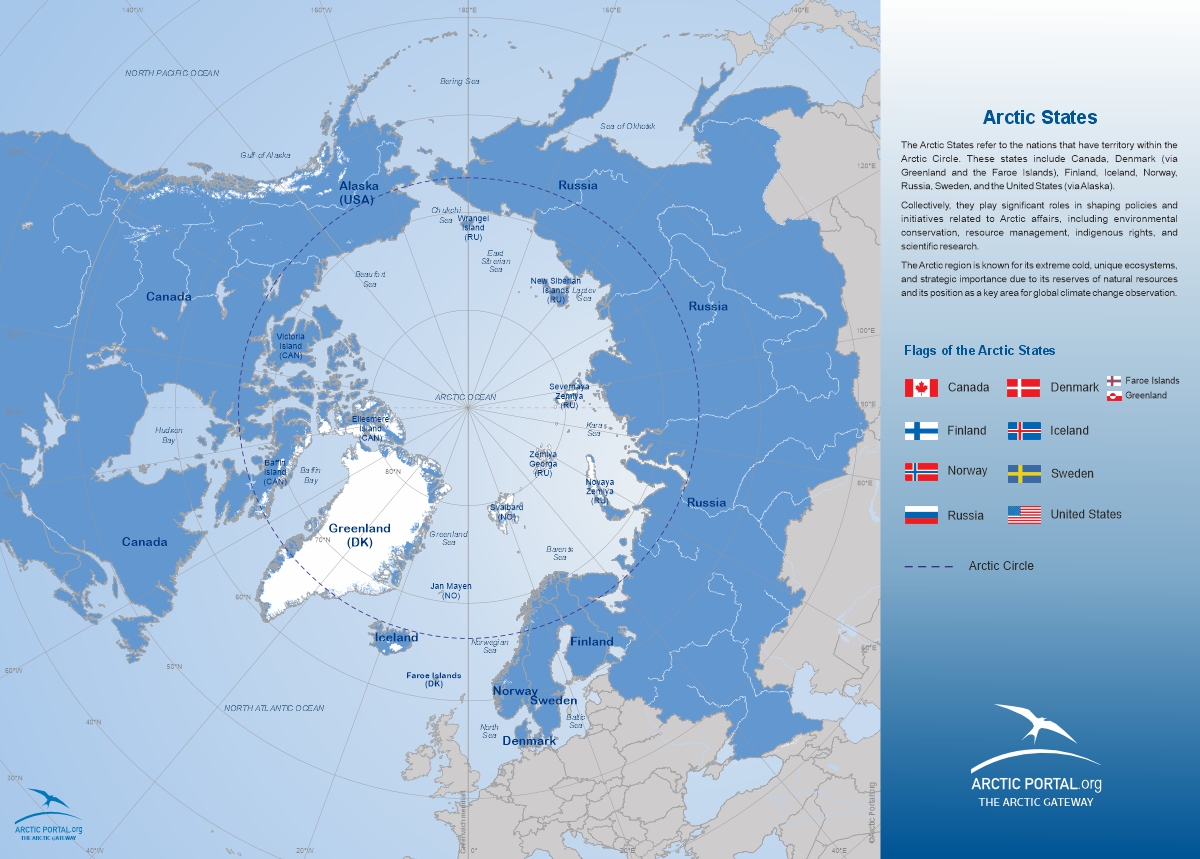 The Arctic region is commonly defined as encompassing eight Arctic states: Canada, the Kingdom of Denmark (through Greenland and the Faroe Islands), Finland, Iceland, Norway, Russia, Sweden, and the United States (through Alaska). Although the Arctic covers vast territories across these countries, the total population living within the Arctic is relatively small, estimated at around four million people.
The Arctic is home to diverse cultures, communities, and Indigenous peoples who have lived in the region for thousands of years. Indigenous groups such as the Inuit, Sámi, Nenets, Chukchi, Aleut, and many others continue to play a central role in Arctic society, governance, and cultural preservation.
From Cold War Frontier to International Cooperation
During much of the 20th century, especially throughout the Cold War, the Arctic was heavily influenced by geopolitical tensions between East and West. The region became strategically important for military operations, nuclear deterrence, and surveillance, leaving large parts of the Arctic isolated from broader international cooperation.
A turning point came in the late 1980s with the political reforms of Perestroika in the Soviet Union. In 1987, Soviet leader Mikhail Gorbachev delivered the famous Murmansk speech, calling for the Arctic to become a zone of peace and cooperation. This opened the door to increased dialogue among Arctic nations.
In September 1989, representatives from the eight Arctic countries met in Rovaniemi, Finland, marking the beginning of formal circumpolar environmental cooperation. The fragile Arctic environment and the growing concern over pollution became key areas of common interest.
The Arctic Environmental Protection Strategy
These early discussions led to the establishment of the Arctic Environmental Protection Strategy (AEPS) in 1991. The AEPS focused on scientific collaboration, environmental monitoring, and cooperation in addressing pollution and environmental threats across the Arctic.
The strategy created several important working groups that continue to operate today, including:
- Arctic Monitoring and Assessment Programme (AMAP)
- Conservation of Arctic Flora and Fauna (CAFF)
- Protection of the Arctic Marine Environment (PAME)
- Emergency Prevention, Preparedness and Response (EPPR)
The AEPS was groundbreaking not only because it brought former Cold War rivals together, but also because Indigenous peoples’ organizations participated directly in the process from the beginning.
Establishment of the Arctic Council
Recognizing the growing importance of Arctic issues on a global scale, the Arctic states established the Arctic Council in 1996 through the Ottawa Declaration.
The Arctic Council serves as the leading intergovernmental forum promoting cooperation, coordination, and interaction among Arctic states, Indigenous Permanent Participants, and other Arctic stakeholders. Its primary focus areas include environmental protection, sustainable development, climate change, biodiversity, shipping, and scientific cooperation.
One of the unique features of the Arctic Council is the formal and active participation of Indigenous organizations as Permanent Participants alongside member states.
Over the years, the Council has helped produce major scientific assessments and agreements that have shaped international understanding of Arctic climate change and environmental transformation.
Arctic Agreements and Regional Cooperation
In 2011, the Arctic states signed the first legally binding agreement negotiated under the Arctic Council framework: the Agreement on Cooperation on Aeronautical and Maritime Search and Rescue in the Arctic. The agreement strengthened international coordination for emergency response across the vast Arctic region.
This was followed by additional agreements on oil spill preparedness and scientific cooperation, reflecting the growing practical importance of Arctic governance as human activity in the region increases.
At the same time, Arctic cooperation has faced new geopolitical challenges in recent years, particularly following Russia’s invasion of Ukraine in 2022. Many Arctic Council activities involving Russia were temporarily paused, highlighting how global politics continue to influence Arctic governance.
Indigenous Peoples and Circumpolar Cooperation
Indigenous peoples’ organizations remain central actors in Arctic cooperation. Cross-border collaboration among Indigenous communities has strengthened over recent decades, especially in areas related to cultural preservation, language revitalization, environmental protection, and human rights.
Organizations such as the Saami Council, Inuit Circumpolar Council (ICC), and RAIPON (Russian Association of Indigenous Peoples of the North) have contributed significantly to international recognition of Indigenous rights and traditional knowledge.
The concept often described as “North meets North” reflects the growing cooperation among Arctic communities themselves, beyond state-level diplomacy.
The Arctic and the Global Community
Today, the Arctic is increasingly connected to the rest of the world. Climate change is transforming the region faster than almost anywhere else on Earth, affecting sea ice, glaciers, permafrost, ecosystems, and local communities.
At the same time, the Arctic’s natural resources, fisheries, renewable energy potential, and emerging shipping routes have increased international interest in the region. Countries from Europe, Asia, and beyond are expanding their scientific, economic, and political engagement in Arctic affairs.
As global attention on the Arctic continues to grow, international cooperation, scientific research, Indigenous participation, and sustainable development remain critical to the future of the region.