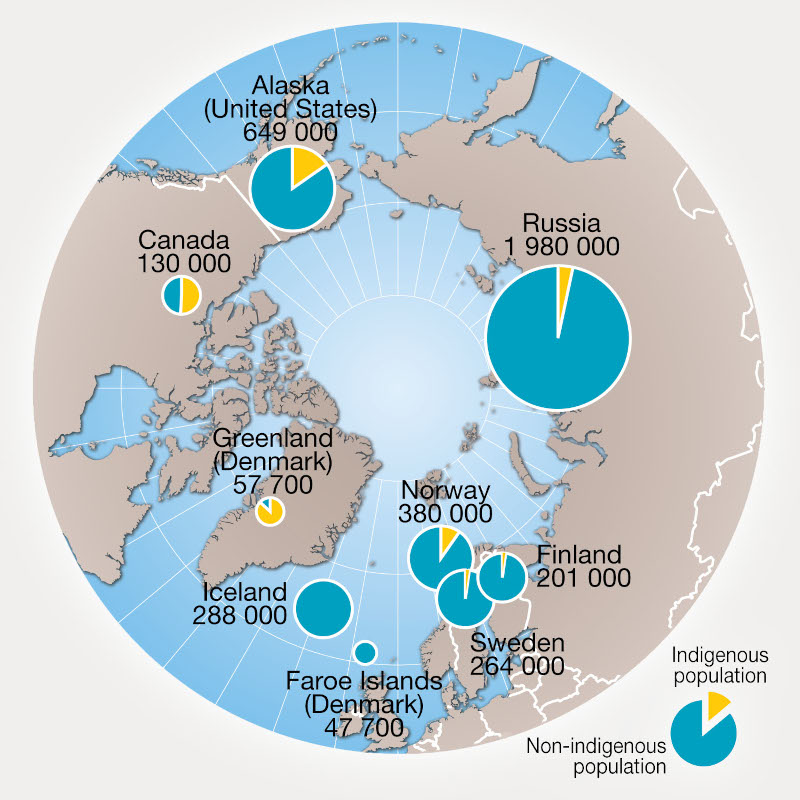
A Sparsely Populated Region
The Arctic covers approximately 40 million square kilometers, or about 8% of the Earth’s surface, yet it is home to only around four million people.
Among these are numerous Indigenous peoples whose ancestors inhabited the region long before the arrival of Europeans. Today, most Arctic Indigenous communities live as minorities within modern nation-states. Greenland is the exception, where Inuit make up approximately 88% of the population. In northern Canada, Indigenous peoples account for roughly half of the population in some regions. In Alaska, Indigenous peoples represent about 20% of the population, while in northern Scandinavia and Russia they make up approximately 4–5%.
Languages of the Arctic
Around 40 Indigenous languages are still spoken across the Arctic. However, Russian, English, and Scandinavian languages are dominant in public life and administration.
Greenland is unique in that Kalaallisut (Greenlandic), an Inuit language, is the official language. In Canada’s territory of Nunavut, Inuktitut, English, and French are recognized as official languages.
Early Arctic Settlement
Archaeological evidence suggests that humans have lived in Arctic regions for at least 12,000 years, based on findings in northern Russia. Some researchers propose even earlier habitation, though this remains debated.
While little is known about the earliest Arctic inhabitants, more is understood about later cultures such as the Inuit and the Sámi, whose histories stretch back several thousand years.
Inuit Origins and Cultural Development
The ancestors of today’s Inuit migrated from Asia to Alaska across the Bering Strait thousands of years ago. Early Arctic cultures relied on hunting marine mammals such as seals, walrus, and whales, as well as land animals including caribou and musk oxen.
Over time, several cultural traditions developed:
- Paleo-Inuit cultures (sometimes referred to historically as Paleo-Eskimo)
- The Dorset culture, which thrived for nearly 2,000 years
- The Thule culture, which emerged around 1,000 years ago and is considered the direct ancestor of modern Inuit
The Thule people developed advanced Arctic technologies, including efficient dog sled transportation, large skin boats (umiaks), kayaks, and sophisticated harpoons. These tools allowed them to hunt whales and other marine mammals successfully.
The word Inuit means “the people” (plural), while Inuk refers to one person. Today, the term “Inuit” is preferred. The word “Eskimo” is considered outdated and, in many contexts, inappropriate.
Traditional clothing made from animal skins, seasonal migration patterns, and strong knowledge of sea ice and animal behavior remain important aspects of Inuit culture, even as modern life and technology have transformed Arctic communities.
The Sámi People
The Sámi are the Indigenous people of northern Europe, inhabiting Sápmi — a region spanning northern Norway, Sweden, Finland, and Russia’s Kola Peninsula.
Archaeological and linguistic evidence suggests Sámi presence in the region for at least 5,000 years. Traditionally, Sámi livelihoods were based on reindeer herding, fishing, hunting, and small-scale agriculture.
Today, many Sámi continue reindeer husbandry, while also participating in modern economic and political life. Sámi parliaments in Norway, Sweden, and Finland provide representative institutions for cultural and political advocacy.
Indigenous Knowledge and Modern Arctic Life
Arctic Indigenous peoples maintain strong cultural traditions while navigating the realities of modern state systems, global markets, and climate change.
Traditional ecological knowledge — built on generations of observation of ice, wildlife, and weather patterns — is increasingly recognized as vital for understanding environmental change in the Arctic.
At the same time, Arctic communities face major challenges, including:
- Rapid climate change
- Economic transitions
- Cultural preservation
- Infrastructure and connectivity issues
A Living and Evolving Arctic
The Arctic is not an empty wilderness. It is a homeland.
It is a region where ancient cultures and modern governance coexist, where Indigenous languages persist alongside global languages, and where traditional subsistence practices intersect with industrial development.
Understanding the peoples of the Arctic is essential to understanding the Arctic itself.
Source:The Arctic by Richard Sale