
Norway


Capital
Oslo

Population
5,677,090 (2026)

Currency
Norwegian krone (NOK)

Government
Parliamentary Monarchy
Highest Mountain
Galdhøpiggen
2,469 m

Longest River
Glomma
523 km

Arctic Circle Crosses
Yes
Northern Norway

Coastline
102,937 km
Including 50,000 Islands and Islets

Timezone
CET (UTC+1)
CEST (UTC+2) summer
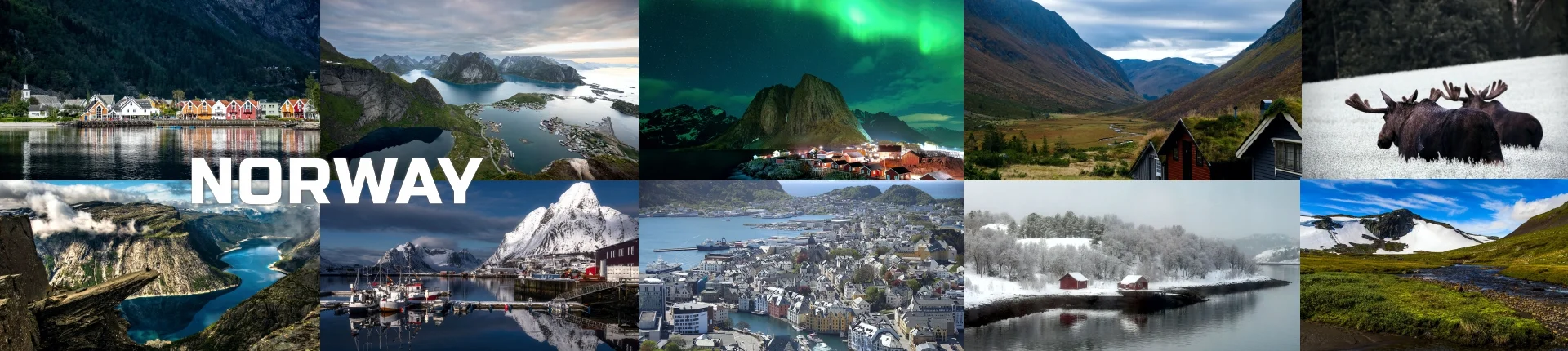
Norway is one of the Nordic countries on the Arctic Council, a member of NATO but not the EU. Norway plays a particularly important role in the Arctic, as it is the guardian of several important access seaways. A large part of the country lies in the Arctic, and its industry, history and national identity are closely tied to it.
Geography and History
About one-third of Norway lies beyond the 66th Parallel, the Arctic Circle, including the Jan Mayen Island and the Svalbard Archipelago. In terms of its foreign policy engagement, Norway distinguishes between the extreme Arctic (referring to the North Pole and the uninhabited areas in the so-called High Arctic) and the more hospitable and populated parts of Northern Norway and Svalbard, deemed the “High North”. 490,000 People live in the Arctic parts of Norway. The country’s Arctic maritime area is approximately 1,500,000 square kilometers.
Officially annexed to the Norwegian territory in 1929, Jan Mayen Island was discovered more than 400 years ago by Dutch whalers. Measuring only 377 km2, it is in fact a volcano that emerged from the Arctic Ocean several thousand years ago. Virtually uninhabited, it is used as a meteorological base for Norway, which has possessed installations there since 1921.
The Svalbard Archipelago, on the other hand, is a region of complex politics. Although under the administration of Norway since 1920, its islands can be freely inhabited and occupied by other nations. With its 61,022 km2, the Archipelago is covered in the vast majority by ice, and ranks among the most northerly lands of the planet. Around 3500 people live here, mainly in coal mining, fishing, and scientific research.
Norwegian history is closely tied to the north and the Arctic. In the 18th century, as part of the union with Denmark, Norway took part in the struggle to define who had access to the Arctic Coast between the Scandinavian countries. The Sámi people often crossed the border between Norway and Sweden to trade and hunt, and to gain access to the Arctic Ocean, which was codified in a supplement to the treaty between Denmark-Norway and Sweden in 1751. This treaty also assigned the region of Finnmark to Norway.
After the Napoleonic Wars, Norway became part of Sweden, and finally gained independence in 1905. Norwegians took part in a number of expeditions into the Polar regions. (add here) Perhaps the most famous Norwegian polar explorers are Fridtjof Nansen and Roald Amundsen. Nansen crossed Greenland on skis and gained international fame for his Fram expedition, before becoming a diplomat after his retirement from expeditions. Amundsen became the first man to reach the South Pole in 1911, and the first man to visit both poles after his fly-over of the North Pole with the airship Norge in 1926. Both men revolutionized polar exploration with their technical and practical improvements, and by learning many of those skills from the Indigenous people in the North.
In the 1920s, Norway acquired the islands of Svalbard and Jan Mayen, and Norwegian hunters and fishermen occupied an area on the east coast of Greenland. Denmark’s demand for sovereignty over the area led to a conflict that was settled in the Permanent Court of International Justice in The Hague in 1933 in Denmark’s favor. In 1939, the government proclaimed that Queen Maud Land in Antarctica was under Norwegian sovereignty.
During the Second World War, Germany invaded Norway in 1940 and occupied the entire country, including a key Arctic port, Narvik. At the end of the war, the German troops in Norway capitulated without offering resistance. On their retreat from Finland in late 1944 and early 1945, however, the Germans burned and ravaged Finnmark and northern Troms. The Soviet troops who liberated eastern Finnmark in November 1944 withdrew during the summer of 1945. The post-war period was characterized by restoration and rebuilding.
Indigenous people
Sámi population in Norway is between 40–50 thousand people, with most residing in the three northern counties. The traditional lands of the Sámi people stretch from Hedmark county in the middle of Norway to the Russian border in the north. Even though the Sámi are a minority in most parts of Sápmi, traditional reindeer herding is still present across the land and takes place in a total of 140 municipalities. The Sámi languages and traditions are part of daily life in Sámi communities, in contrast to other parts of society where Norwegian culture dominates. The traditional livelihoods of the Sámi are dependent on land, over which there are at times conflicts in the North of Norway.
Since its opening in 1989, the interests of the Sámi population have been ensured by the Sámediggi, Sámi Parliament, which resides in Karasjok, Finnmark. The opening of the Parliament was seen as the end of an assimilation policy enforced by the Norwegian government since the 1850s. Norway was subsequently one of the first countries to ratify the ILO Convention No. 169 on Indigenous and Tribal Peoples in Independent Countries, which ensures the Indigenous peoples’ right to consultation before decisions regarding them are made. In 2005, the Sámi Parliament and the Norwegian government signed an agreement which formalizes the procedures for consultation on all relevant policy issues.
Economy
Fishing and marine resources, in addition to livestock husbandry, have for centuries been the cornerstone of the economy in Northern Norway. Today’s economy is much more diversified, but Nordland County is still Norway’s third largest exporter of marine fisheries and aquaculture. Today’s key industries also include tourism (Norway’s broad Arctic region attracts a growing number of tourists, who come to experience dramatic scenery and largely untouched wilderness), sustainable energy, power, mining and transit.
Arctic Governance and Research
Norway held the country’s first Arctic Council chairmanship from 2007-2009, where the priorities included integrated resource management in sectors including fisheries, mining, maritime transport, petroleum and economies; climate change monitoring and assessment; reviewing the structure of the Arctic Council to ensure effectiveness and efficiency; monitoring the long-range transportation of pollution; preventing pollution and reducing releases of hazardous substances; protection of the marine environment, conservation of biological diversity; and social, human health and economic development with due regard for the interests of Arctic Indigenous Peoples.
Norwegian security policy is predominantly focused on the relationship with Russia, which takes place in the Arctic, but is not framed as an Arctic endeavor. Instead, the High North is central to security considerations.
Norway is home to various research institutes and institutions that focus on the Arctic. It houses the world’s northernmost university, the Arctic University of Norway, in Tromsø, as well as the NORD University in Bodø, the FRAM High North Research Centre for Climate and the Environment, and the Fridtjof Nansen Institute. Furthermore, the Norwegian Polar Institute has earned international recognition for scientific research on polar territories.
Today, Norway hosts the Arctic Council secretariat in Tromsø as well as many other international Arctic institutions' secretariats, including APECS and CliC Project Office. Most recently, it has been announced that Tromsø will also host the Coordination Office for the Fifth International Polar Year.
Read Norway in the North - A High North policy for a new era
Sources: Arctic Territory, CIA World Factbook, Framsenteret, The Arctic Institute, The Arctic Council, Polarhistorie.no, Britannica