
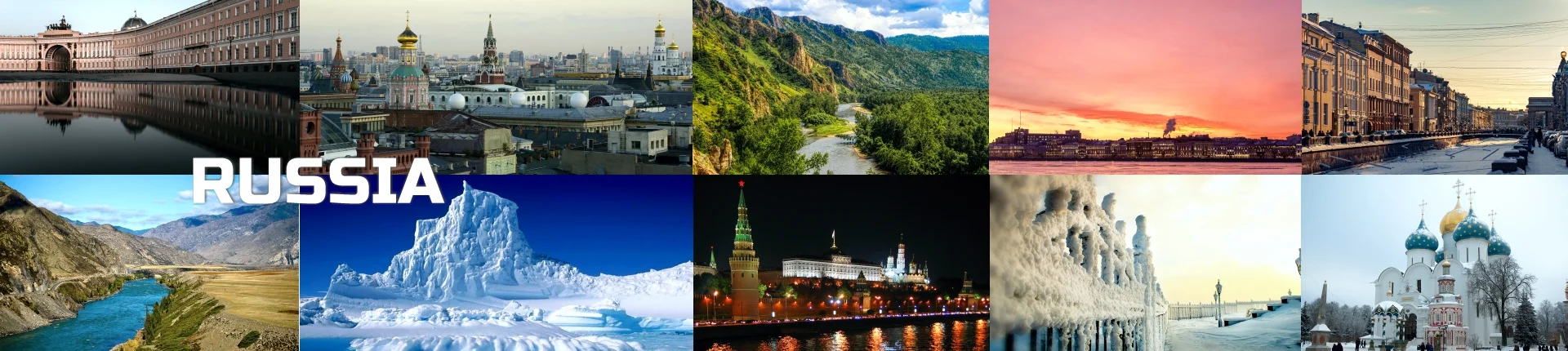
Russia


Capital
Moscow

Population
143,394,458 (2026)

Currency
Russian ruble (RUB)

Government
Federal Semi presidential Republic
Highest Mountain
Mount Elbrus
5,642 m

Longest River
Ob-Irtysh
5,410 km

Arctic Circle Crosses
Yes
Russia has the Arctic's longest coastline and crosses the Arctic Circle

Coastline
37,653 km
Including seas and Islands in the Arctic Ocean (Europe & Asia)

Timezone
11 time zones
From UTC-11 to UTC+12
Russia is the largest country in the world and covers more than half of the land in the Arctic. It is home to many indigenous groups and has a very strong identity as an Arctic State. Arctic governance has mostly been centralized with direct influence from Moscow.
Geography and History
Russia’s coastline accounts for 53 percent of the Arctic Ocean coastline and covers the Barents Sea, Kara Sea, Laptev Sea, and East Siberian Sea. Throughout the country’s Arctic waters, a number of archipelagos can be found, most prominently the Novaya Zemlya in the Kara Sea, Severnaya Zemlya in the Laptev Sea, and the New Siberian Islands in the East Siberian Sea. To the north-east of the Norwegian archipelago of Svalbard, Russia’s Franz Josef Land is located just 950 kilometers from the North Pole. Russia’s Arctic population counts approximately 2 to 2,5 million people, about half of the people living in the Arctic worldwide.
The territorial expansion of the empire governed from Moscow from the sixteenth century onward led north and east and soon led to encounters with the Indigenous people living there. Conflict, voluntary trade, colonization, and Christian missionization took place. In the seventeenth century, trade along rivers vastly expanded, and local natural resources of the Russian North were efficiently used and exploited. Fur, especially from sable and otter, was a wanted commodity in Europe. There was a high level of bureaucratization and organizational innovation, including the participation of foreign merchants. Shipbuilding and shipping became important features.
While expanding eastwards and northwards into Siberia, Russians developed different mechanisms of control over large territories, including a series of fortified settlements. This thin amount of control remained resilient, and a much more intense colonization followed in the eighteenth century, under the rule of Peter the Great. Infrastructure and industry grew massively, in an effort to modernize and westernize the vast country. However, vast numbers of settlers in Siberia couldn’t be sustained by the short growing seasons, and that proved one of the barriers to Russian expansion in the region; Russian power there depended on cooperation with the local Indigenous people. They themselves were changed by the economic opportunities brought by the colonization. Russia also employed the discipline of natural history to survey Siberia, sending expeditions to map and document it. In the nineteenth century, this interest was institutionalized in the Russian Imperial Geographic Society, founded in 1845.
The early twentieth century saw an interplay between Nationalism and Internationalism in the Russian Arctic. For example, Russia collaborated on the Swedish-Russian Meridian Expedition’s joint research in Spitsbergen at the turn of the century. Through the end of the Russian Empire, the authorities considered the region a resource or an object of study, and the local inhabitants were of little interest. After the Russian Revolution in 1917, the scale and scope of Arctic exploration and settlement increased greatly as part of the work of developing the northern sea route. A number of cities were established in an effort to populate the North. Political prisoners were sent to labor camps in Siberia and Indigenous religion was suppressed. Polar stations, of which five already existed in 1917, increased in number, providing meteorological, ice reconnaissance, and radio facilities. By 1932 there were 24 stations, by 1948 about 80, and by the 1970s more than 100. The use of icebreakers and, later, aircraft as platforms for scientific work was developed. During World War Two, the Arctic played a key role in transportation, but much infrastructure was destroyed.
During the Cold War period, the Soviet Union and the US participated in an extensive arms race, the Arctic becoming one of the main playgrounds for nuclear submarines. In Siberia, most labor prison camps were closed after the death of Stalin in 1953, and the USSR worked on making the Arctic easier to live in via planning, organization of industry, and attracting workers from other parts of the country. The Arctic became the most rapidly urbanized area in the USSR. Indigenous people were often displaced from their homes due to these developments and isolated from their culture. The last leader of the Soviet Union, Mikhail Gorbachev, envisaged the northern polar region as an arena for cooperation and argued for putting aside Cold War militarization, a movement that would later characterize the 1990s in the Arctic space.
Indigenous people
Of Russia’s 41 legally recognized Indigenous small-numbered peoples of the North, Siberia, and the Far East, 11 reside around or above the Arctic Circle. Lovozero in Murmansk Oblast is considered the Russian “Sámi capital,” with 2,800 inhabitants. Russia’s Arctic is home to approximately 67,000 Indigenous people. The largest indigenous groups in Russia are the Dolgan, Nganasan, Nenets, Sámi, Khanty, Chukchi, Evenk, Even, Enets, Eskimo (or Yupik), and Yukagir.
The Federal Agency for Ethnic Affairs is a federal agency of the Russian Government tasked with nationality and ethnic policy. The organization Russian Arctic Indigenous Peoples of the North (RAIPON) represents the Indigenous people of the Russian Arctic and works with the State Duma and the Government of Russia regarding legislation related to Indigenous Peoples’ issues. It is also a Permanent Participant in the Arctic Council and participates in international structures such as the United Nations Economic and Social Council with a special consultative status and the Governing Council, and the Global Ministerial Environment Forum of the United Nations Environment Program as an observer.
Economy
In the Arctic context, Russia is perhaps one of the most significant influences, playing a key role both in Arctic oil and gas development as well as in Arctic Shipping. It is estimated that vast amounts of the Arctic undiscovered petroleum reserves are situated on the Russian continental shelf. In addition, it is becoming clearer that the Northeast Passage has more potential to become the main Arctic shipping route from Asia to Europe due to the sea ice retreat and open ice conditions over the summer months.
Arctic Governance
Russia has been a member of the Arctic Council since 1996, and held the chairmanship in 2004 – 2006 and in 2021 – 2023. On Account of its size, efficient and sustainable development of the Arctic is one of the key national priorities. Other key national interests in the Arctic include: the use of the Arctic region as a strategic resource base of Russia, providing solutions to the task of socio-economic development of the country; preservation of the Arctic as an area of peace and cooperation; conservation of the unique ecosystems of the Arctic; and the use of the Northeast Passage / Northern Sea Route as a national unified transportation line of Russia in the Arctic.
Russia’s attack on Ukraine in 2022 led to a pause in the Arctic Council’s activities. Seven of the Arctic Council member states condemned Russia’s military actions in Ukraine, while many other Arctic organizations suspended working with Russia. Russia’s Arctic policy has since centered on domestic development. During Norway’s chairmanship in 2023-2025, with official Arctic Council meetings still on pause until further notice, the Norwegian chairmanship initiated an innovative approach to continue in-person meetings between the chairmanship, Permanent Participants and Working Groups. In February 2024, consensus was reached for the gradual resumption of official Working Group meetings in a virtual format, enabling project-level work to advance. The virtual meetings include all eight Arctic States and six Permanent Participants.
Read the Foundations of the Russian Federation State Policy in the Arctic for the Period up to 2035
Sources:CIA World Factbook, The Arctic Institute, The Arctic Council, Britannica, The Cambridge History of the Polar Regions