
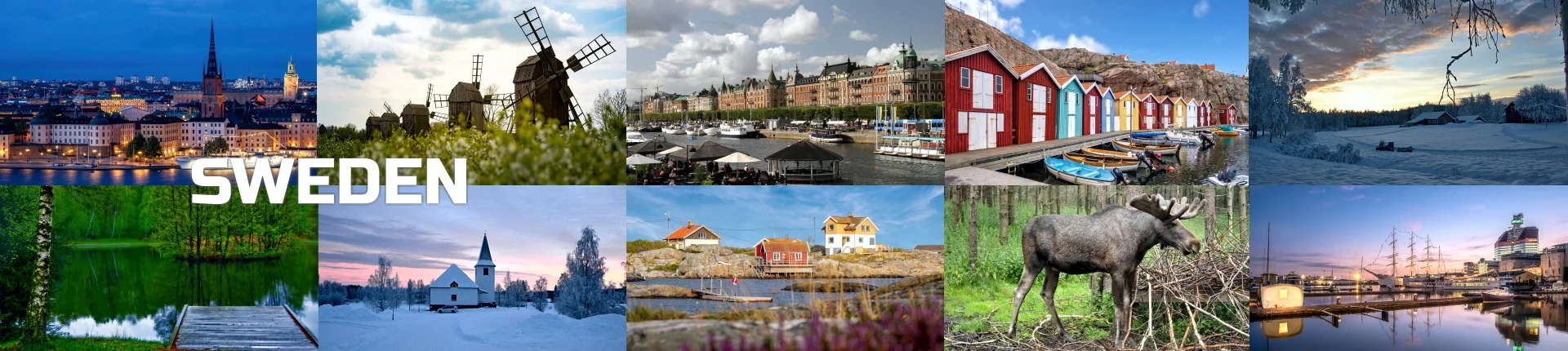
Sweden


Capital
Stockholm

Population
10,714,431 (2026)

Currency
Swedish krone (SEK)

Government
Parliamentary Dem.
Constitutional Monarchy
Highest Mountain
Kebnekaise
2,097 m

Longest River
Klarälven
460 km

Arctic Circle Crosses
Yes
Northern Sweden

Coastline
3,218 km
Including Islands

Timezone
CET (UTC+1)
CEST (UTC+2) summer
Sweden is a member of both the EU and NATO. One of the Nordic countries on the Arctic Council, Sweden places importance on sustainability and good organization. It is home to a significant Sámi population.
Geography and History
Only about 15% of Sweden lies truly beyond the Arctic Circle. The two northernmost counties, Västerbotten and Norrbotten, are defined as Sweden’s Arctic territory, and include the province of Lappland. This region represents about one-third of Sweden’s territory but is populated with just over half a million inhabitants. Sweden has no Arctic coastline. The largest agglomeration is the city of Kiruna, with 22 thousand inhabitants in 2019.
In the 16th century, Swedish King Gustav Vasa declared that all wilderness areas that had not been previously entered into the registers of ownership belonged to the Crown. This included large areas in the north of the country. The King also encouraged citizens without land or house to move to the Crown lands in the north as settlers. He, however, also added the proviso that the new settlements should not be allowed on the hunting rights of the Sámi and issued strict regulations governing trade and fishing in the north. His son Charles IX spearheaded the beginning of Arctic policy.
By the 17th century, Sweden became a major power in Europe and sought to establish its northern border at the Arctic Ocean. In 1673, a decree was published concerning the colonization of the northern parts of the realm, with a border that was supposed to separate the Sámi and the Finns. In 1751, revisions were made to the border between Denmark-Norway and Sweden, leading Sweden to lose significant overland connections to the Arctic Ocean, but the Sámi could still cross the new border.
In the 19th century, Norway and Sweden formed a two-state union. In the 1860s, Sweden was the main power in Svalbard, driven by “purely scientific motives”. Polar Explorer Adolf Erik Nordeskiöld led expeditions to the archipelago, discovering mining opportunities. The archipelago today is under Norway, which gained independence in 1905. The first iron ore mine in the Swedish Arctic was opened in 1647, and in the Norbotten district iron ore was mined in the 17th century. However, in the 19th century, excellent quality iron was found in what is today Kiruna. In the early 20th century, mining became the principal industry, developing rapidly after a railroad linked Kiruna with the port of Narvik in Norway in 1902. The iron from Kiruna was used to make steel by both the Allies and Nazi Germany in the Second World War. Today, Kiruna remains one of the largest iron-ore producing complexes in the world.
Indigenous People
Sweden hosts a Sámi population of 20 000, many of them living in some of the 51 Sámi villages found in the country. During the 17th and 18th centuries, the Swedish church undertook extensive missionary work among the Sámi, and many Sámi religious practices were shunned, the sacred Sámi drums were confiscated, and human remains were taken to museums and research institutes. Today, many of them have been returned, but the debate on the historical heritage of these colonialist practices continues, along with Sámi protests against the use of land in Sápmi for mining or forestry without consultation. The Sámi were recognized as indigenous peoples by the Swedish government in 1977, and the Sámi Parliament was established in 1993.
Mining and Forestry
The mining industry is very prominent in Northern Sweden. Sweden is the European Union’s (EU) largest mining nation, producing over 90% of the EU’s iron ore and almost 20% of its base and precious metals. Mining accounts for 7.5% of Sweden’s northern economy, with another 7.2% made up of resource processing. However, it has also led to environmental concerns over waste materials, heavy metal leaching, water contamination, and habitat destruction. Kiruna, built on top of an iron ore mine, is in the process of moving three kilometres east by 2033 to avoid collapsing into the mine pit.
The forest industry in Norrbotten, Västerbotten, Jämtland, and Västernorrland generates an annual contribution of over SEK 50 billion to the regional economy. Nearly half of this consists of spillover effects to other sectors. Despite its reputation, Sweden has surprisingly light forestry laws. The result of lax regulation is the loss of large swaths of biologically rich boreal forests.
Arctic Governance and Research
Sweden held the country’s first Arctic Council chairmanship from 2011-2013. Throughout the chairmanship, Sweden’s priorities included the environment and climate, Arctic people, Arctic Sea and land surveillance, and strengthening the Arctic Council. Under the Swedish Chairship the standing Arctic Council Secretariat was established in Tromsø, Norway. The Swedish Chairmanship adopted the Arctic Council Communication Strategy to communicate the Council’s work and progress to the public. Sweden will hold the country’s second chairmanship in 2027-2029.
Northern Sweden is home to research stations in Abisko and Tarfala as well as the EISCAT12 scatter radar facility in Kiruna. An extensive environmental monitoring program on temperature, precipitation, ice-thaw, flora and fauna in the Abisko area has been in progress there for nearly 100 years. The Tarfala Research Station, located in the Kebnekaise mountains, conducts basic research, glacier monitoring, meteorological and hydrological analyses, snow chemistry, and permafrost studies.
Read Sweden's strategy for the Arctic region
Source:CIA World Factbook, The Arctic Institute, The Arctic Council, Britannica, The Cambridge History of the Polar Regions, Footprints in the Snow: The Long History of Arctic Finland, High Latitudes: The History of Swedish Polar Exploration,